Nanny taxes in Florida (2026): what Miami families need to know
By Tom Smedley, founder · Published · Last updated

If you hire a nanny, housekeeper or nanny-housekeeper directly in Miami, you become an employer. That sounds heavier than it is. For most families it comes down to a few thresholds, a handful of forms and some dates to put in the calendar. This guide covers what applies in 2026, using the official IRS and Florida figures, so you can get it right from the first paycheck.
This is general information, not tax advice. Every household is different, so please check your own situation with a tax adviser or accountant.
Are you a household employer?
The IRS test is about control. In the words of IRS Publication 926, a worker is your employee "if you can control not only what work is done, but how it is done." It doesn't matter whether the work is full time or part time, or whether you pay by the hour, the day or the week.
A nanny who looks after your children in your home, on your schedule, following your routines, is almost always your employee. The same goes for a housekeeper who comes on set days and works to your instructions. Someone who runs their own business, brings their own tools and serves many clients, such as a cleaning company that sends a different team each visit, is usually not.
If you've hired someone directly, it's safest to assume they're your employee and plan for the taxes below.
The federal rules for 2026
All figures in this section come from IRS Publication 926 (2026).
Social Security and Medicare (FICA). These apply if you pay one household employee $3,000 or more in cash wages in 2026.
- Social Security tax is 6.2% for you and 6.2% for your employee, on wages up to $184,500 in 2026.
- Medicare tax is 1.45% for you and 1.45% for your employee, with no wage limit.
- That's 7.65% each. You normally withhold your employee's share from their pay, or you can choose to pay it yourself.
- If an employee's wages go over $200,000 in a year, you also withhold an extra 0.9% Additional Medicare Tax on the amount above that.
The $3,000 test is per employee, and only cash wages count. Wages you pay to your spouse, your child under 21, your parent (with some exceptions) or an employee under 18 (unless household work is their main job, and it isn't if they're a student) don't count.
Federal unemployment tax (FUTA). This applies if you pay $1,000 or more in total cash wages to household employees in any calendar quarter of 2025 or 2026.
- The rate is 6.0% on the first $7,000 of each employee's wages in the year.
- You can usually take a credit of up to 5.4% for state unemployment tax you pay, which brings the net rate down to 0.6%. To get the full credit for 2026, pay all your 2026 Florida reemployment tax by April 15, 2027.
- FUTA is paid by you only. Never deduct it from your employee's pay.
Federal income tax. You don't have to withhold it. You withhold it only if your employee asks and you agree, using the Form W-4 they give you.
Live-in staff. Meals you provide at your home for your convenience, and lodging you provide at your home for your convenience and as a condition of the job, aren't counted as wages. Cash you give instead of meals or a room does count. We'll cover live-in arrangements in more detail in a later post.
Florida: reemployment tax, and no state income tax
No state income tax. The Florida Department of Revenue confirms that Florida doesn't impose a personal income tax. There's no state income tax to withhold from your nanny's pay and no state income tax return for them to file.
Reemployment tax. This is Florida's version of unemployment tax. According to the Florida Department of Revenue:
- A private home that pays $1,000 or more in cash in a calendar quarter for domestic services is liable. You're also liable if you owe federal unemployment tax.
- The tax applies to the first $7,000 of each employee's wages in a calendar year.
- The initial rate for new employers is 2.7%. Employers with stable records can get a lower rate after a qualifying period.
- Workers don't pay it, and you must not deduct it from their pay.
- You register through the Department's online Florida Business Tax Application (or paper Form DR-1).
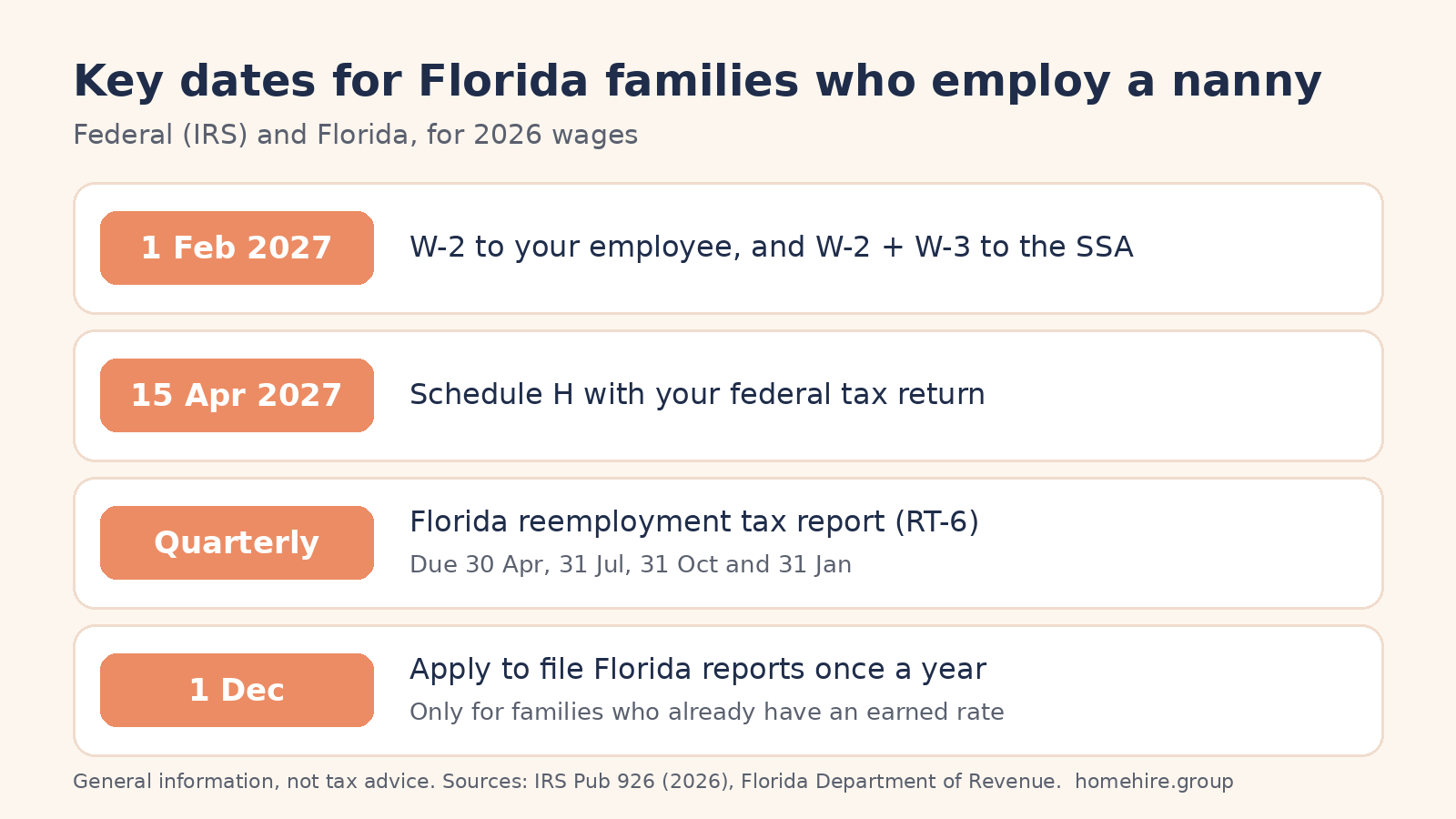
Quarterly or yearly filing. Most employers file the Employer's Quarterly Report (Form RT-6). It's late if not postmarked by the last day of the month after each quarter: April 30, July 31, October 31 and January 31 (moved to the next working day if that's a weekend or holiday).
Household employers have a second option. If all your employees do domestic work only and you've been assigned an earned tax rate (meaning you've reported for the required number of quarters and now have a rate other than the initial one), you can apply to file once a year instead. The application is Form RT-7A, and it must be postmarked no later than December 1 to file annually in the following year. The annual report is due January 1 and is late if not postmarked by January 31.
So if you've employed household staff for a while and already have an earned rate, December 1 is the date to watch if you'd like one filing a year in 2027. If you're a new household employer, you'll start on quarterly filing.
Your paperwork checklist
- EIN. Get a free employer identification number from the IRS at irs.gov/ein. You'll need it for the W-2 and Schedule H.
- Form I-9. Your employee completes their section no later than their first day of work, and you both complete the form when you hire someone to work for you regularly.
- Form W-2. For 2026 wages, give your employee Copies B, C and 2, and file Copy A with Form W-3 at the Social Security Administration, both by February 1, 2027. You don't send a W-2 to the SSA if Social Security and Medicare wages were under $3,000 and you didn't withhold federal income tax.
- Schedule H. File it with your 2026 federal income tax return (Form 1040) by April 15, 2027. Schedule H is where you report Social Security, Medicare and FUTA for your household employees.
- Paying through the year. Household employment taxes are paid with your own return, so the IRS suggests making estimated tax payments or asking your own employer to withhold more from your pay. That way you avoid a large bill, and possibly a penalty, in April.
- Florida. Register for reemployment tax and file RT-6 each quarter (or RT-7 yearly, once you qualify).
- Records. Keep your employment tax records for at least 4 years after the return's due date or the date you paid the tax, whichever is later.
A simple illustration
Say you pay one nanny $40,000 in cash wages across 2026 and you're a new Florida employer. This is an example to show how the rates work, not a guide to what to pay.
- Social Security and Medicare: 7.65% of $40,000 is $3,060 from you, plus $3,060 withheld from your nanny's pay.
- FUTA: 0.6% of the first $7,000 is $42, assuming you get the full state credit.
- Florida reemployment tax: 2.7% of the first $7,000 is $189.
For what Miami families actually pay, see what Miami nannies cost and what Miami housekeepers cost.
Florida minimum wage
According to FloridaCommerce, Florida's minimum wage is $15.00 an hour from September 30, 2026 through December 31, 2027. Every paid hour, including a paid trial day, must meet it.
Childcare tax help
If your nanny looks after a child under 13 so that you (and your spouse, if filing jointly) can work or look for work, you may be able to claim the child and dependent care credit. See IRS Publication 503 for the rules, or ask your tax adviser.
Getting help
We're adding payroll through our partner in early 2027, subject to confirmed availability. Until then, many families use a household payroll service or an accountant to run paychecks, file the forms and keep the dates.
On HomeHire, families hire directly: you post your job, talk to candidates and choose who to hire, and you're the employer. Free for families until January 2027, and candidates never pay.
If you're starting your search, see hiring a nanny in Miami or how to hire household staff in Miami directly. For more on how HomeHire works, read our FAQ or the guide for families.
This article is general information about federal and Florida rules as published on October 26, 2026. It isn't tax or legal advice. Rules and figures change, so please check with a tax adviser before you file.
Frequently asked questions
Do I have to pay taxes for my nanny in Florida?
If your nanny is your employee and you pay them $3,000 or more in cash wages in 2026, you owe Social Security and Medicare tax. If you pay $1,000 or more in cash wages to household employees in any calendar quarter, you also owe federal unemployment tax and Florida reemployment tax. Florida has no state personal income tax, so there is nothing to withhold for the state.
What happens if I pay my nanny under $3,000 in 2026?
Social Security and Medicare tax don't apply to that employee's 2026 wages, and you don't send a W-2 to the Social Security Administration unless you withheld federal income tax. Federal and Florida unemployment tax can still apply if your total cash wages to household employees reach $1,000 in any calendar quarter.
Does Florida have a household employment tax?
Yes, reemployment tax. A private home that pays $1,000 or more in cash in a calendar quarter for domestic services is liable. The employer pays it on the first $7,000 of each employee's wages each year, at an initial rate of 2.7% for new employers. Workers don't pay it, and you can't deduct it from their pay.
Is my nanny a contractor or an employee?
According to IRS Publication 926, a worker is your employee if you can control not only what work is done but how it is done. A nanny or housekeeper who works in your home on your schedule and follows your instructions is usually your employee, whether they work full time or part time.
When are the W-2 and Schedule H due?
For 2026 wages, give your employee their copies of Form W-2 and file Copy A with Form W-3 at the Social Security Administration by February 1, 2027. File Schedule H with your 2026 federal income tax return by April 15, 2027.
Related pages
Sources
- IRS Publication 926 (2026), Household Employer's Tax Guide (retrieved 26 October 2026)
- IRS Instructions for Forms W-2 and W-3 (2026) (retrieved 26 October 2026)
- IRS Instructions for Schedule H (2025, latest published) (retrieved 26 October 2026)
- IRS Publication 503 (2025, latest published), Child and Dependent Care Expenses (retrieved 26 October 2026)
- IRS, Apply for an Employer Identification Number (EIN) (retrieved 26 October 2026)
- Florida Department of Revenue, Reemployment Tax (retrieved 26 October 2026)
- Florida Department of Revenue, Reemployment Tax Return and Payment Information (annual filing option) (retrieved 26 October 2026)
- Florida Department of Revenue, Form RT-7A, Application for Annual Filing for Employers of Domestic Employees (retrieved 26 October 2026)
- Florida Department of Revenue, Do I have to file a personal income tax return in Florida? (retrieved 26 October 2026)
- FloridaCommerce, Florida Minimum Wage (retrieved 26 October 2026)